



One of the most common things I hear from new clients is some version of: "I hate my website and I need a new one." What they usually mean is: "I hate how it looks." What they assume that means is: tear it down and start over.
It's almost never that simple. And starting from scratch when you don't need to is one of the most expensive mistakes you can make.
After years of inheriting sites, auditing platforms, and helping clients figure out what their site actually needs, I've landed on a framework I use every time someone comes to me convinced they need a full rebuild. Most of the time, they don't. Sometimes they absolutely do. The difference comes down to a few specific signals and almost none of them are about how the site looks.

What "Redesign" Actually Means
There's real confusion in this space about terminology, so let's clear it up first.
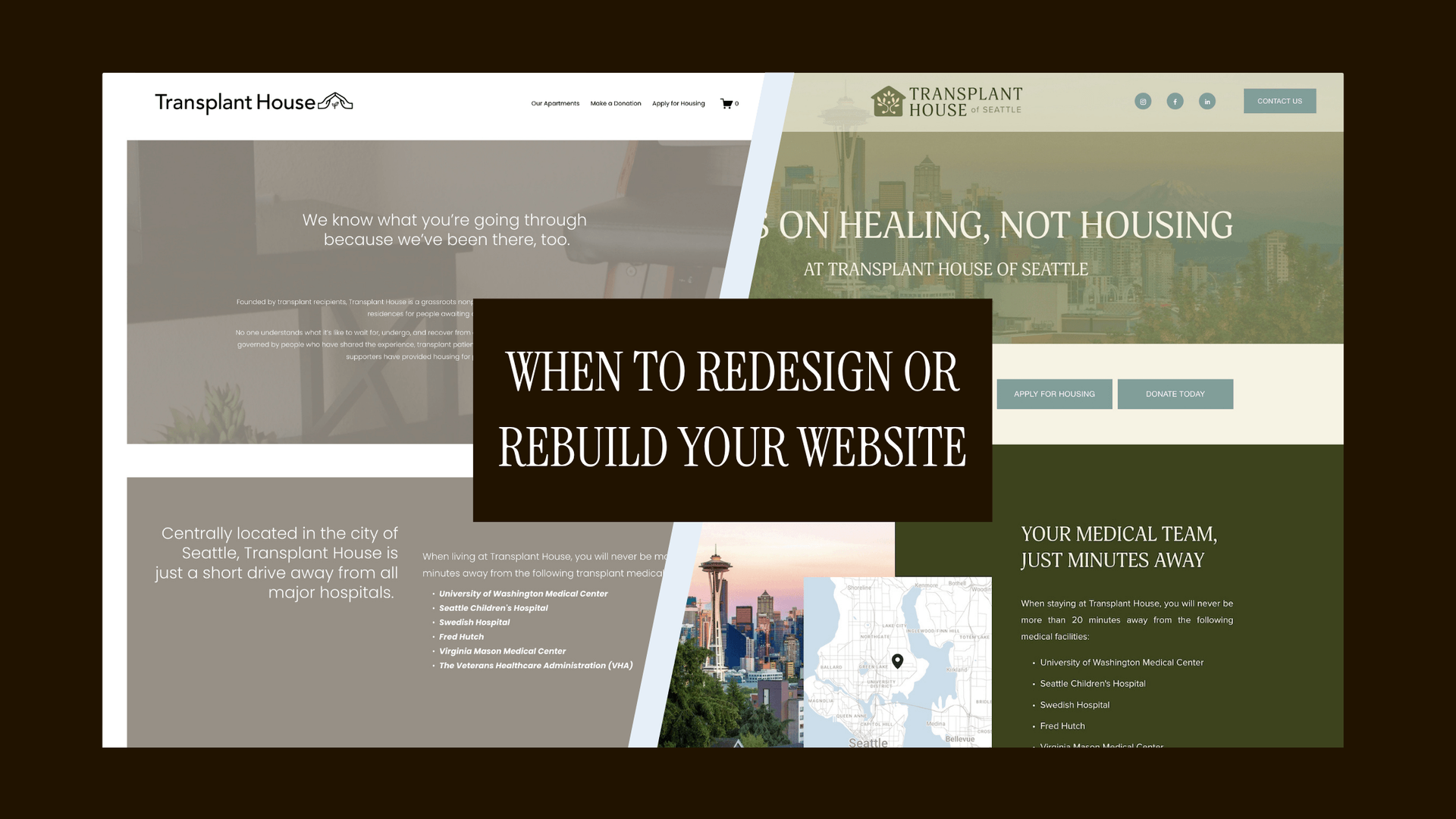
A website redesign or website refresh means updating the visual design — fonts, colors, photos, layout — without touching the underlying structure or platform. If your site was built well, on a platform your team can actually use, a refresh can give you a completely new look without rebuilding anything. On platforms like WordPress with Kadence or Elementor, Squarespace's Fluid Engine, or Webflow, a design refresh is often a matter of updating your design system rather than starting from zero.
A rebuild means starting over from scratch — possibly a new platform but definitely a new structure, new content architecture, new copy. It's the right call when the foundation itself is broken or wrong. But it's a much bigger investment of time and money, and it's not always what the problem requires.
Most people conflate the two. When they say "I need a redesign," they often mean refresh. When they're quoted a price for a full rebuild, they assume that's just what redesigns cost. The disconnect is expensive.
The Real Question: Was Your Site Built Right the First Time?
This is the question nobody asks, and it's the one that actually determines your path.
If your site was built on a sustainable platform with a proper design system, meaning clean page templates, consistent styles, and a builder your team can use, then updating the design doesn't require rebuilding the site. You're working within a system that was designed to be updated. That's the whole point of platforms like Squarespace, Webflow, and WordPress with a quality builder.
If your site was built on custom code, a heavily modified theme with layers of overrides, or a platform that's now wrong for your needs — that's a different story.
I have a client right now with nearly a decade of content on a fully custom-coded site. The design is outdated, yes — but that's almost beside the point. The content is stale, the platform can't support what they need today, and no one who currently works there can touch it without breaking something. That's a rebuild. Not because of aesthetics, but because the foundation has run its course.
The Refresh vs. Rebuild Decision Matrix
I shared this framework at a nonprofit web design and branding webinar earlier this year and it tends to cut through the confusion quickly. Here's how to read it: if the signal points to Refresh, you likely don't need to start over. If it points to Rebuild, the foundation itself needs to change.
| Signal | Refresh | Rebuild | Question to Ask First |
|---|---|---|---|
| Outdated design only | ✓ Update fonts colors photos | ✗ Not necessary | Is the structure and navigation still working? |
| Navigation is confusing | ✓ Reorganize pages & labels | Maybe — depends on platform | Can pages be restructured without a platform change? |
| Wrong platform for your needs | ✗ Lipstick on a pig | ✓ Time to rebuild | Is the platform limiting what your business needs to do? |
| Pages missing or incomplete | ✓ Add + update content | ✗ Not necessary | Is the content gap a writing problem or an architecture problem? |
| Slow or broken functionality | ✓ Fix plugins/settings first | Only if unfixable on current platform | Can this be resolved without changing platforms? |
| Business model has changed | Maybe — depends on scope | ✓ Likely time to rebuild | Has your offer or audience changed enough to require new structure? |
| Can't edit it yourself | ✓ Fix with training or new theme | Consider platform switch | Is the barrier training or is the platform itself the problem? |
| SEO underperforming | ✓ SEO refresh first | Only if architecture is broken | Are URLs page structure and internal linking salvageable? |
| Content is outdated or thin | ✓ Rewrite and update existing pages | Only if structure is also broken | Is this a content problem or an architecture problem? |
| Site isn't mobile responsive | ✓ Usually a platform fix | Only if site predates responsive design | Was the site ever built to be responsive or was it always desktop-only? |
| Security issues or repeated hacks | ✓ Update plugins and improve hosting | Only if custom-coded with no maintainer | Is there someone who can actually maintain and secure this codebase? |
The row I'd draw your attention to is "wrong platform for your needs." That one almost always means rebuild because putting a new design on the wrong foundation is, as I put it in the webinar, lipstick on a pig. You'll be back in the same situation in two years.
When to Refresh
If your site was built on a solid platform and most of these are true, a refresh is probably the right move:
- The design feels dated but the structure and navigation make sense
- Your team can currently update the site without developer help
- The platform still fits your business model and scale
- Your SEO rankings exist and you don't want to risk losing them
- The content is largely current and just needs updating
A well-executed refresh on a well-built site can look completely new. I've done full visual overhauls on Squarespace and WordPress sites that clients described as "feeling like a brand new website" because the design changed completely, even though the underlying architecture stayed intact. That's the whole point of building on a sustainable platform to begin with.
When to Rebuild
A rebuild makes sense when the foundation can no longer support what you need, not just what you want it to look like. If several of these are true, it's probably time:
- The site is custom-coded and no one on your team can update it
- You've outgrown the platform entirely and it can't do what your business now requires
- The content architecture is fundamentally broken — wrong URL structure, no logical hierarchy, years of accumulated mess that can't be untangled
- You're migrating to a new platform for other reasons anyway
- The site has so many custom code overrides that even your developer can't make changes without things breaking
- A major rebrand is happening that requires rethinking the whole structure, not just the surface
The distinction I always come back to: if the problem is how it looks, that's almost certainly a refresh unless it's custom coded. If the problem is how it works — or how it was built — that's when you're looking at a rebuild.
How Often Should You Actually Redesign a Website?
The honest answer: there's no universal timeline. Anyone who tells you "every three years" is guessing.
What actually drives the decision is whether the site is still working for your business. A well-built site on a modern platform that's being actively maintained and updated doesn't have a natural expiration date. The design can be refreshed as your brand evolves. The content can be kept current. The platform will handle changes without requiring a rebuild.
A poorly built site on the wrong foundation will feel outdated faster because it was never set up to be a living, evolving part of your org or business. You end up rebuilding not on a schedule, but because something breaks or the gaps become impossible to work around.
The better question than "how often should I redesign" is: was my site built to last? If yes, you maintain and refresh. If no, you're on borrowed time regardless of how old it is.
Not Sure Which One You Need?
If you're staring at your site and genuinely can't tell whether you need a refresh or a full rebuild, that's actually a sign you need an audit before a proposal. Any designer worth hiring should be able to look at what you have and give you an honest answer — not just default to recommending a full rebuild because that's the bigger project.
I offer a free mini audit for exactly this kind of situation. And if you're ready to talk about what a redesign or rebuild would actually involve, you can learn more about my website redesign services or get in touch directly.
FAQs
How often should you redesign your website?
There's no universal timeline. A well-built site on a modern platform can be refreshed as needed without a full rebuild. The real question is whether your site is still working for your business — not how many years it's been since launch.
What is the difference between a website refresh and a website rebuild?
A refresh updates the visual design — fonts, colors, layout, photos — without changing the underlying platform or structure. A rebuild means starting over with a new platform, new architecture, and often new content. Refreshes are faster and less expensive; rebuilds are necessary when the foundation itself is wrong.
How do I know if I need a new website or just an update?
Start by asking whether the problem is how the site looks or how it works. Aesthetic issues are almost always fixable with a refresh. Functionality problems, platform limitations, and content architecture issues are signs you may need a rebuild.
What makes a website need a full rebuild?
The most common reasons are: the site is custom-coded and no one can maintain it, the platform no longer fits your business needs, or the content and URL structure have become too broken to fix incrementally. A major rebrand that changes your entire offering can also trigger a rebuild.
Can I redesign my website without losing my SEO?
Yes, if done carefully. A refresh that keeps your URL structure, page titles, and content intact carries minimal SEO risk. A full rebuild requires careful redirects, content migration, and post-launch monitoring to protect rankings. I cover this in more detail in my guide to website redesign services.
How much does a website redesign cost?
It depends entirely on whether you need a refresh or a rebuild, your platform, and the scope of work. A refresh on an existing well-built site is significantly less expensive than a full rebuild. I cover this more on my website redesign services page.

Don't know where to start? Get your free mini audit.
Actionable tips, resources, and feedback to get you moving.